Is renting a car in Thailand a good idea?
For most visitors to Phuket and southern Thailand, yes. A rental car lets you reach quiet beaches, viewpoints and temples on your own schedule, carry luggage and children safely, and avoid negotiating taxi fares several times a day. Main roads are generally good, fuel is affordable and there are no toll roads on Phuket.
It does take some adjustment: traffic drives on the left, scooters pass on both sides and some junctions use U-turn slots instead of right turns. Read Driving in Thailand: rules and road habits before your trip and you will settle in quickly.
Who can rent a car?
Most suppliers rent to drivers aged 21 and over; some accept younger drivers for a fee and some, like Sixt, start at 18 for certain car groups. Typical rules:
- Under 25: a young-driver charge often applies.
- Vans, luxury cars and convertibles: often limited to drivers aged 25 or over.
- Licence held: usually at least one year, sometimes two or more for premium cars.
- Upper age limits: uncommon, but a few suppliers have them – check the conditions.
The exact rules for each offer are shown in the rental conditions before you book.
Documents to bring to the desk
- Your full, valid driving licence (not a provisional licence).
- An International Driving Permit (1949 Geneva Convention) – required with most licences issued outside ASEAN. It must be issued in your home country before you travel.
- Your passport – the original, not a copy.
- A credit card in the main driver's name for the security deposit.
- Your booking voucher, printed or on your phone.
Missing documents are the most common reason a rental is refused at the desk, and the booking is usually not refundable in that case. Pack them together in your hand luggage.
What the price usually includes
Prices shown in our search normally include:
- Collision Damage Waiver (CDW) – limits what you pay for damage to the rental car.
- Theft protection (TP) – limits what you pay if the car is stolen.
- Compulsory third-party insurance required by Thai law.
- Unlimited mileage on most offers.
- Local taxes and airport fees.
CDW and TP still leave you with an excess – the amount you pay if something happens. Read Car hire insurance in Thailand explained to understand it and decide whether to reduce it.
Deposits explained
At pick-up the supplier blocks a refundable security deposit on your credit card. It is not a charge – the money stays on your card but cannot be spent. The amount depends on the car group and the cover you choose, and it usually matches the excess.
- Make sure your card limit covers the deposit plus your holiday spending.
- Debit cards and prepaid cards are often refused.
- The block is released after you return the car undamaged; your bank can take several working days to show it.
Fuel policy
Full-to-full is the most common policy: you get the car full and return it full. If you return it with less fuel, the supplier charges for the missing fuel plus a service fee, which is usually far more than the pump price. Keep the last fuel receipt.
Most rental cars in Thailand take Gasohol 91 or 95; larger SUVs, pickups and vans often take diesel. The correct fuel is usually printed inside the fuel flap.
Choosing the right car
For most couples an economy or compact car is enough for Phuket's roads. Families usually prefer a compact SUV or midsize SUV for the higher seating on steep hills and the extra boot space, and groups of seven or more need a 7-seater, an 8-seater or a passenger van.
Almost every rental car in Thailand is automatic, but check the gearbox on vans. Remember that you book a car group – the model is "or similar".
Picking up at Phuket Airport
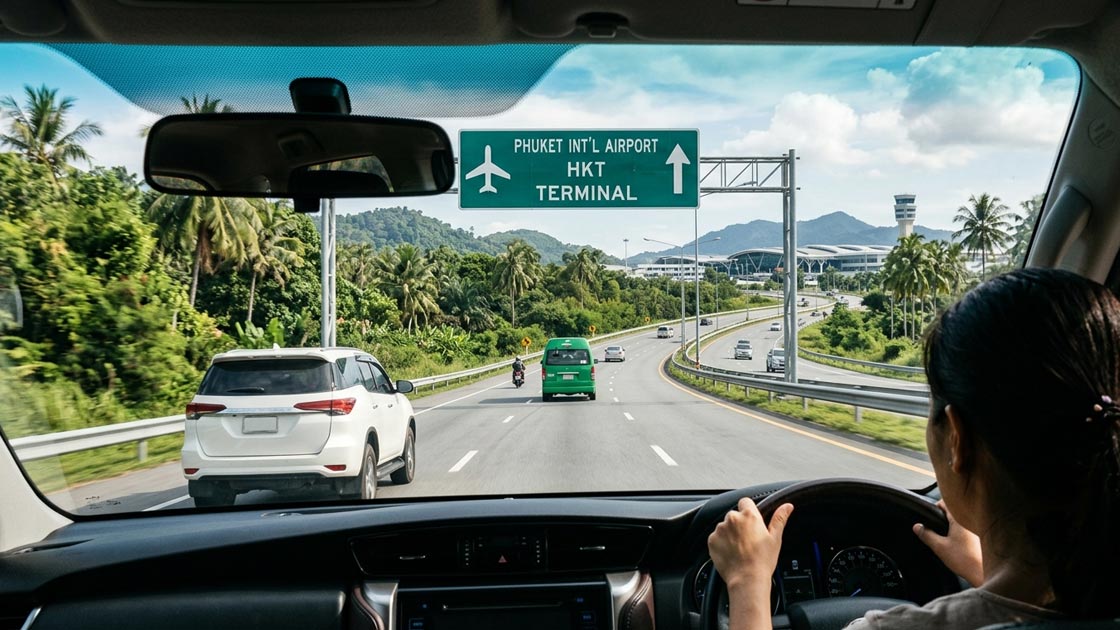
Most rental desks are in the Domestic Terminal arrivals hall; if you land on an international flight, walk next door in a few minutes along the covered walkway. Some local suppliers meet you in the arrivals hall with a name sign instead. Your voucher shows the exact meeting point, the desk phone number and the opening hours – see the Phuket Airport guide for a map.
At the car, walk round with the staff member, film a slow video and make sure every scratch is noted on the damage sheet before you drive away.
Extras: child seats, additional drivers and GPS
- Child seats: Thai law requires young children to travel in a suitable child seat. Request them when you book – they are limited in high season and charged per day.
- Additional drivers: everyone who drives must be named on the contract and show their licence at the desk, otherwise the insurance does not cover them. There is usually a daily fee.
- GPS: rarely worth paying for – a phone with a local SIM or eSIM and offline maps works well.
- Toll tags: not needed on Phuket; there are no toll roads on the island.
One-way rentals
Picking up at Phuket Airport and dropping off in Krabi, Surat Thani, Trang or Hat Yai is possible with the larger suppliers, usually for a one-way fee that is shown in the total price. It is ideal for a road trip that ends with a flight home from another airport. See one-way car rental for the routes.
Taking rental cars on ferries – for example to Koh Samui or Koh Lanta – or across borders into Malaysia is generally not allowed.
Charges to watch for
- Young-driver fee (usually under 25)
- One-way fee if you drop the car somewhere else
- Out-of-hours pick-up or return
- Additional driver fee
- Refuelling charge if the car is not returned full
- Cleaning fee for heavy sand, smoking or pets
- Late-return charge – often a full extra day
All supplier fees that apply to your booking are shown in the rental conditions before you pay.
Step by step: from booking to drop-off
- Compare and book – choose the car group, check the deposit, excess, fuel policy and desk hours.
- Add extras – child seats and additional drivers when you book.
- Pack your documents – licence, IDP, passport, credit card and voucher.
- Collect the car – check it carefully and note all damage.
- Drive – follow Thai road rules and keep the contract in the car.
- Refuel and return – on time, with the agreed fuel level, and get a signed return slip.
Returning the car
Return the car with the agreed fuel level, at the time on your contract – many suppliers charge a full extra day once you are more than an hour or so late. Photograph the car, the fuel gauge and the mileage, ask for a signed return sheet and keep your paperwork until the deposit is released. For the drive back, see Driving to Phuket Airport: times from every beach.